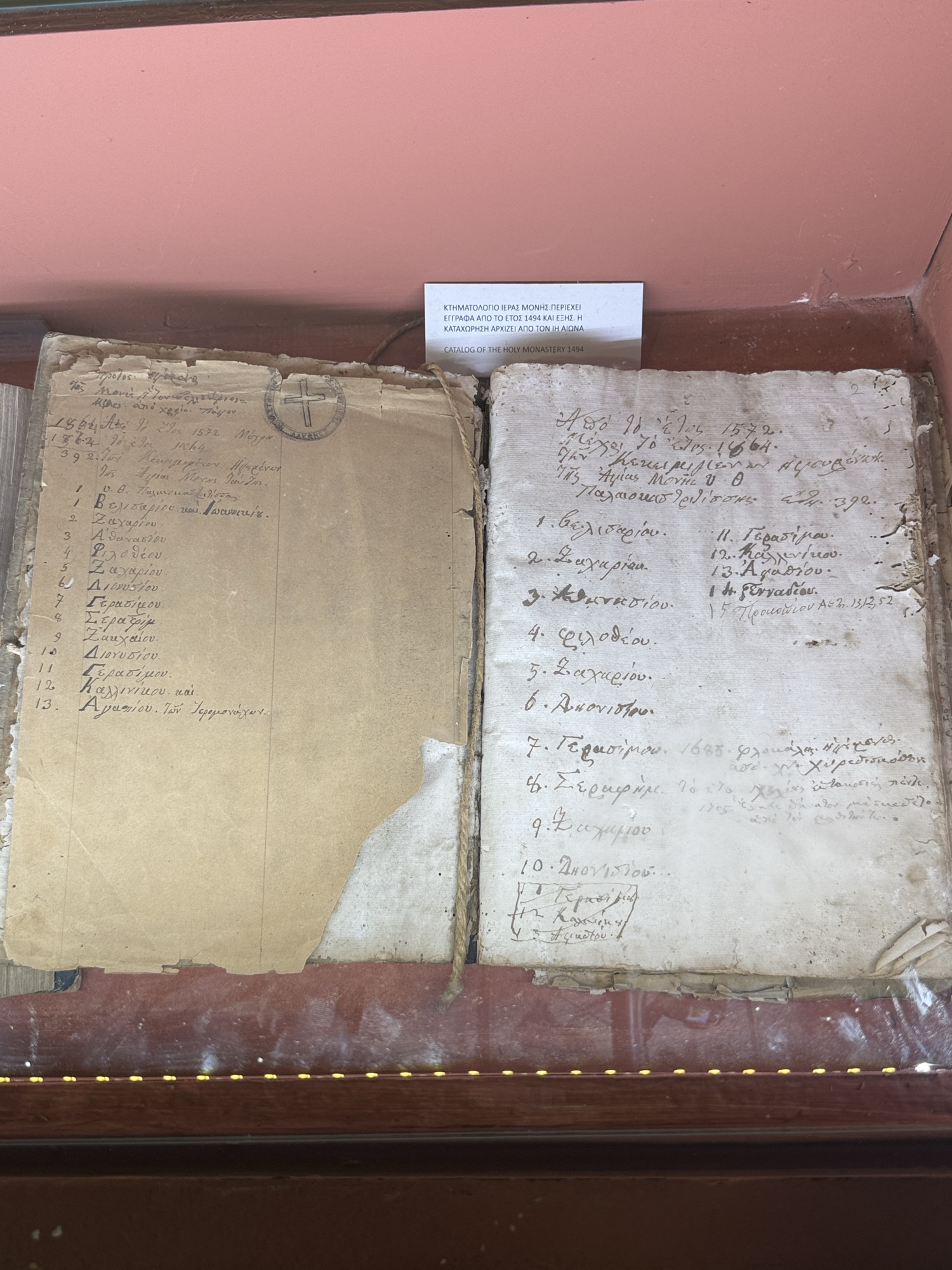

I am writing this from Corfu, where today I came across a manuscript labelled “Catalogue of the Holy Monastery, 1494.” at the Monastery at Paleokastritsa. I could not read it, as it is, quite literally, all Greek to me. But I found myself standing in front of it looking at the writing rather than the words. The catalogue itself is not immaculate, it looks like a working document: practical, uneven in places and probably produced by somebody with a job to do rather than an audience to impress. It is a record of things that mattered enough to be listed, organised and preserved.
Nearby, though, were other manuscripts where the handwriting was extraordinary. The characters were formed with a level of care and precision that was difficult to take in. There was balance, rhythm and patience in every line, even without being able to understand the language, the skill involved was utterly amazing. It was writing as a craft, as art and, perhaps most importantly, writing as evidence that somebody cared.
My dad, a professional who always looked the part, spoke the part and acted like a gentleman. Professionalism was not a job title, it was visible in how he behaved, how he treated people and how he conducted himself. It also showed in the letters and memos he wrote, even though his writing was much like the catalogue, not immaculate!
But he took the time to think about what needed to be said, and he made sure it was clear. He considered the recipient, the tone and the possible consequences. A written communication was not just a task to get through before moving on to the next thing, it reflected on him.
I was never able to have that same written care, I found writing difficult, grammar irritating and spelling impossible! Computers changed working life in ways that were overwhelmingly useful, especially for me. They made communication faster, easier to share and simpler to amend. They removed many of the barriers that once made writing feel like a specialist skill, and helped people like me be able to spell, have correct grammar and express myself.
But even as we moved from letters to emails, and from typewriters to laptops, the important parts remained human. We were still responsible for the thought and decided what we believed, what we wanted to say and how we wished to say it. The machine helped us put words on the page, but did not provide the opinion, the judgement or the accountability.
Over time, writing has also become one of the ways we assess professionalism. Whether fairly or not, people tend to make assumptions from an email, a report or a post. Clear writing, good grammar, the right tone and a coherent argument have become markers of competence. I don’t think this is unreasonable either, even though this has been a thorn in my side. Writing clearly often makes us think clearly, it requires us to decide what is important, organise an idea and consider how it will land with another person.
But AI is beginning to complicate that assumption. We can now produce polished, well-structured and grammatically correct content in moments. An email can become more diplomatic or a report can be made more concise. A rough idea can be turned into a LinkedIn post with a hook, a narrative arc and a neat conclusion before the kettle has boiled (let’s not talk about ink drying!)
That question is becoming more immediate as the discussion around AI watermarking, content provenance and AI labelling gathers pace. The technology is not universal, and it is certainly not foolproof. There are genuine questions about what can be detected, what can be reliably labelled and whether a label can distinguish between AI generating an entire article and AI helping someone correct a paragraph.
Even so, the idea of labelling changes the conversation. Until now, much of the debate has been about what AI can do quickly and can it sound like a real person (me) actually wrote it?
Increasingly, the question may become whether we are comfortable with a reader knowing that AI played a significant part in creating or assessing the work. This is not necessarily about shame or dishonesty, a person might use AI openly and responsibly, just as they use spellcheck, an editor, a researcher or a colleague to test an idea. The issue is not that every use of AI should be treated as suspect.
But if we know that our use of it could be visible, we may start making more conscious choices. Do we use it to help us find a better structure, while keeping the argument and language our own? But does even that highlight its use and therefore question the authenticity? Or do we reject it completely.
Perhaps that is what we risk losing when we judge writing only by its apparent quality. AI can reproduce the shape of polished communication. It can give us the clean grammar, the balanced sentences and the reassuringly confident tone. But it cannot automatically give us lived experience, responsibility for an opinion or a genuine reason for saying something.
I do not believe that the occasional spelling mistake should suddenly be treated as proof that something is authentic. Careless writing is not inherently more human or more trustworthy. The manuscripts I saw were a reminder of the opposite, that care matters, skill matters and taking pride in words matters.
Watermarking may not stop people using AI, and it should not need to. But it could make us pause. It may make us think more carefully about where AI is helping, where it is replacing us and what we are prepared to claim as our own work. If it encourages us to take more care with our ideas, our words and the responsibility that comes with putting our name to them, then perhaps AI will not diminish the value of human writing.
Perhaps it will remind us why it mattered in the first place. Maybe it will help us recapture our humanity in our words.