
I’ve spent enough time with automation to know how it usually goes. You fix one irritating task, then another, then another. Before long, you’ve got a tidy-looking set of agents all doing something useful, but you’re still the one keeping the lot stitched together. I got to that point myself. On paper it looked clever enough: content, reviews, updates, dev loops, project sync. In practice, it was a bit like rugby in the wet. Plenty of effort. A fair bit of mud. Not always much control.
That was the issue. I’d automated tasks, not outcomes. Each part could do its job, but I was still doing the joining-up in my own head. Still deciding what mattered, what needed action, what could wait. The machinery was there. The coordination still sat with me.
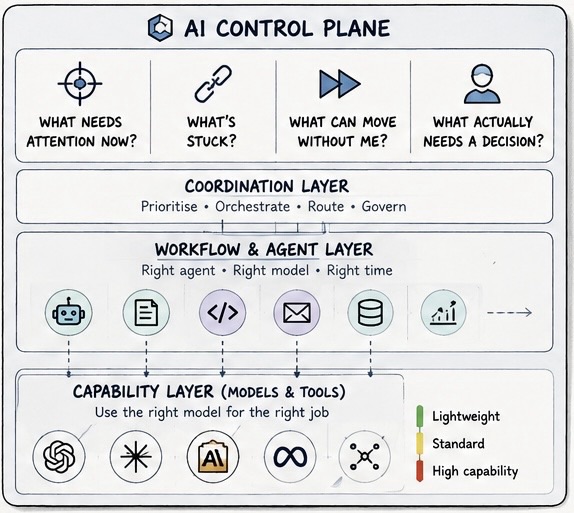
So I’ve been rebuilding it around a simpler idea: not more isolated agents, but an AI control plane. I don’t want a box of bots doing party tricks. I want one system that helps me run the business properly. What needs attention now? What’s stuck? What can move without me? What actually needs a decision, rather than another notification pretending to be one?
That shift I found really matters. It’s easy enough now to bolt on another agent. Tooling is everywhere, and if you’ve got enough duct tape and optimism you can make something impressive in an afternoon. The hard bit I found was coordination. Making the whole thing legible enough that you can trust it, govern it, and improve it without carrying the full map in your own head.
That’s the difference between telemetry and control. Telemetry tells you things happened, control helps you decide what to do next. Plenty of AI setups still do the first while claiming they’ve cracked the second.
I’ve also learned that context beats capability. If every agent has its own tools, prompts, memory and odd little habits, you get sprawl quickly. What starts off looking flexible, ends up looking like a garage full of half-finished projects. Better, in my view, to keep the front end thin and put the real capability behind proper governance. Cleaner. Easier to trust. Easier to change when the business changes, which it always does.
And cost matters. If every small task gets thrown at the most expensive model available, that’s not strategy, that’s just down right sloppy. A decent system should know when a lightweight model is enough, when a workflow should just run, and when something genuinely needs a stronger model and a human decision on top.
Then there’s trust. Good automation doesn’t just do things well, It knows when not to do them. Draft, don’t publish. Prepare, don’t send. Ask before acting. Just because the pass is technically on doesn’t mean you sling it out the back and hope for the best. Sometimes the sensible move is to hold the ball.
For any business, that matters more than most people realise. The real cost isn’t just whether a task gets completed. It’s the drag, the context switching, the low-grade mental clutter of half-made decisions and things you meant to come back to. That’s what eats your week.
So my test now is pretty simple: does this reduce my drag or not? If it takes away the checking, nudging, remembering and reconnecting of context that should already be connected, it’s useful. If not, it’s just more noise dressed up as innovation.